
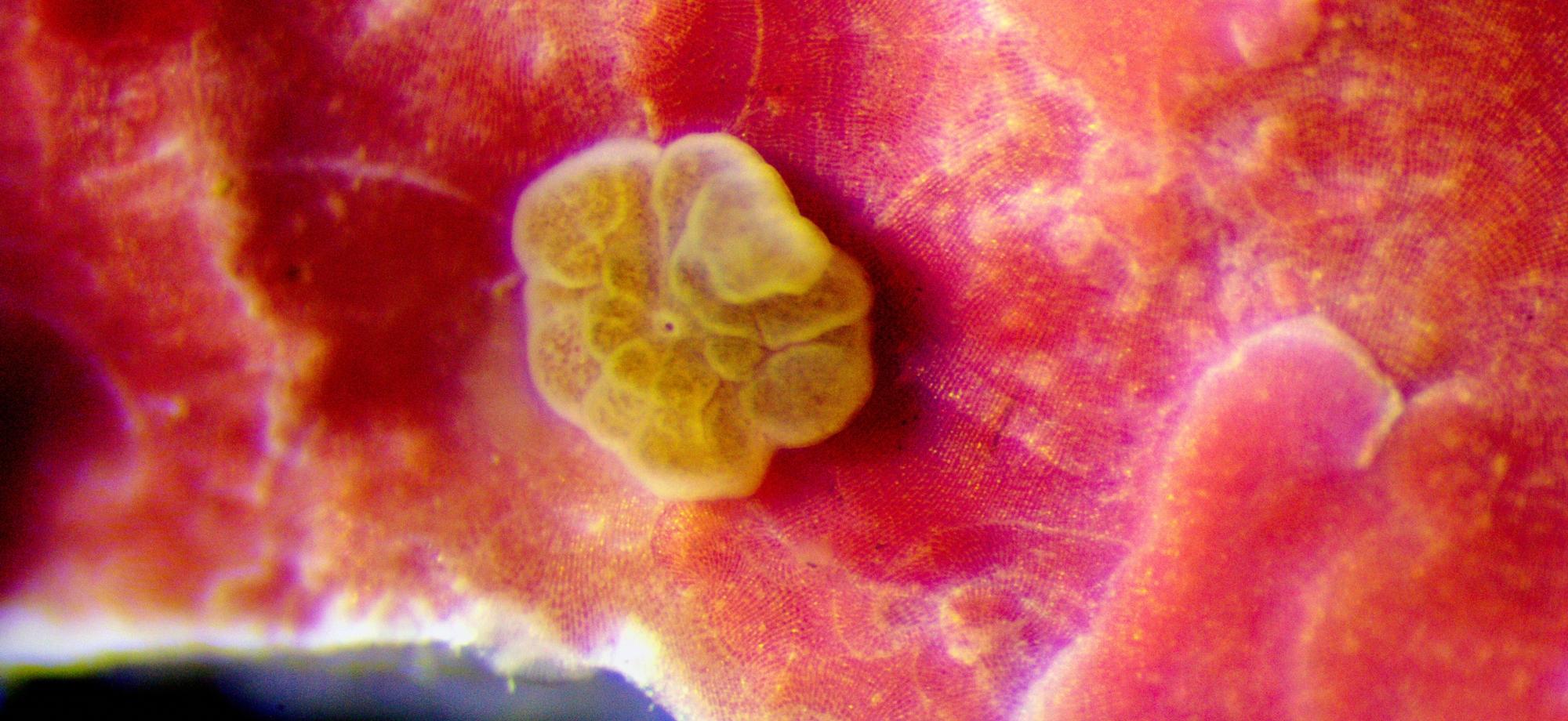
Coral conservation aquaculture has some notorious bottlenecks: points in the process where things become expensive or labour intensive. Overcoming bottlenecks means we can make coral conservation aquaculture more efficient and produce baby corals at the scale needed to support reef restoration.
One such hurdle is the need to prepare the surfaces upon which free-swimming coral larvae settle and grow into viable baby corals.
Scientists have found that coral larvae – though simple animals – are picky about where they choose to spend the rest of their lives. They need a natural biofilm of microbes and crustose coralline algae (different coral species even like different types of algae!) on their preferred stable surface.
To reproduce this surface in the National Sea Simulator (SeaSim), we currently condition tiles in seawater over 9-12 weeks.
The problem with this method, when performed at scale, is that it is time consuming, labour intensive, requires large amounts of valuable aquaria space, and success for coral settlement can be variable.
Coral researchers have therefore been developing alternative materials to coat the tiles, aiming to settle more baby corals with less time and effort. Early trials have shown promise, but on a small scale under a limited set of conditions.
Spawning 2026: testing new substrates in realistic conditions
This spawning season, AIMS and our partners will be testing these newly developed substrates in the SeaSim, allowing us to apply conditions which are much more realistic for large-scale coral aquaculture.
We will use 5L tanks, in contrast to previous testing in well plates which are 10mL. There will also be a flow of seawater through the tanks, which means better water quality, maintained temperature, more dissolved oxygen, and the clearing of any excess nutrients.
Two new substrates will be tested in 2026:
- ReefTiles, developed by researchers at The University of Queensland and San Diego State University, is a non-living bacterial coating that has the same effect of encouraging coral larvae settlement as living marine bacteria. Trials have shown it matches or exceeds settlement from live biofilms, while doing away with concerns about releasing live microbes into the wild.
- SNAP-X, developed through research led by Scripps Institution of Oceanography, is a biomaterial which mimics the chemical landscape of healthy reefs. It is made from silica nanoparticles, biopolymers and algal exometabolites. It is designed to release chemical signals slowly and be easily applied to natural reef substrates. Trials have shown a 20-fold enhancement of coral settlement.
These new substrate technologies will be tested in different formats and with a number of species of coral. The measure of success for each substrate treatment will be the proportion of coral settlement tabs that could be used in seeding devices for coral conservation aquaculture.
Substrates for the future
For AIMS, successful results in these trials could mean replacing our current method (of conditioning tiles with seawater) with another that is cheaper, consistent and more reliable. This would dramatically reduce a major bottleneck in our coral aquaculture process.
These trials could also be a step towards developing low-cost, off-the-shelf products accessible to coral aquaculture practitioners around the world.
Researchers
Dr Muhammad Abdul Wahab (AIMS)
Dr Andrew Negri (AIMS)
Dr Lone Hoj (AIMS)
Dr Samantha Goyen (AIMS)
Carine Lefevre (AIMS)
Makeely Blandford (AIMS)
Dr Daniel Wangpraseurt (Scripps Institution of Oceanography)
Zain Smith (Scripps Institution of Oceanography)
Paul Mercurio (Scripps Institution of Oceanography)
Dr Laura Rix (The University of Queensland)
This research is supported by:
Australian Institute of Marine Science


