
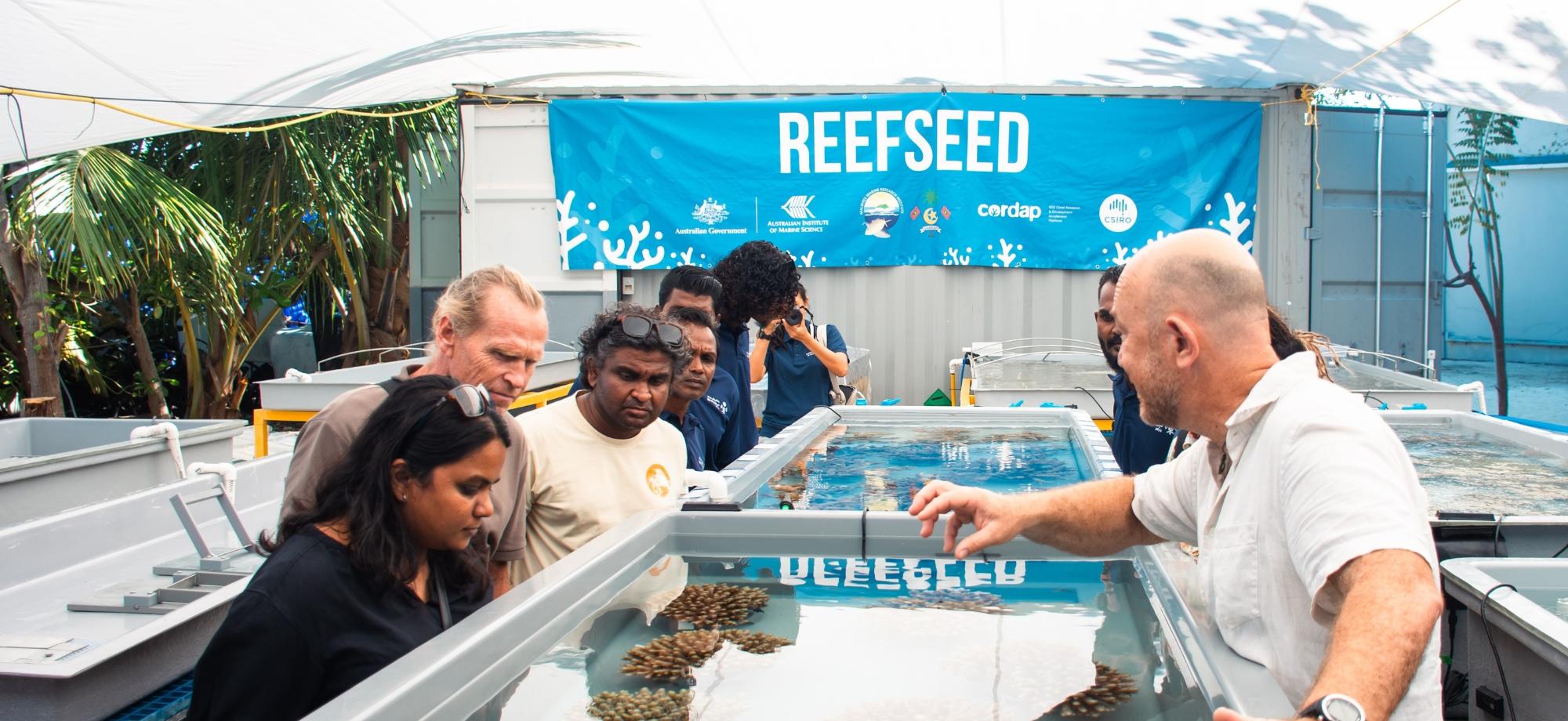
ReefSeed is an innovative, transportable, and standalone containerised coral aquaculture system capable of producing millions of coral larvae in remote regions for reef restoration.
Compared to manual coral spawning methods, ReefSeed is designed to maximise fertilisation success and larval production while significantly reducing labour costs for reef restoration.
The global effort to restore reefs
Coral aquaculture techniques are being developed at AIMS and across the world to support large-scale efforts to fast-track reef recovery in the future.
AIMS’ research efforts focus on scaling up the production of healthy young corals to numbers that can be used across entire reefs or regions. This is happening alongside other reef restoration approaches.
We are also developing end-to-end solutions to support the successful operationalisation and use by reef communities in remote regions, independent of large-scale aquaculture facilities and measuring on-the reef success in ecological, social and economic dimensions.
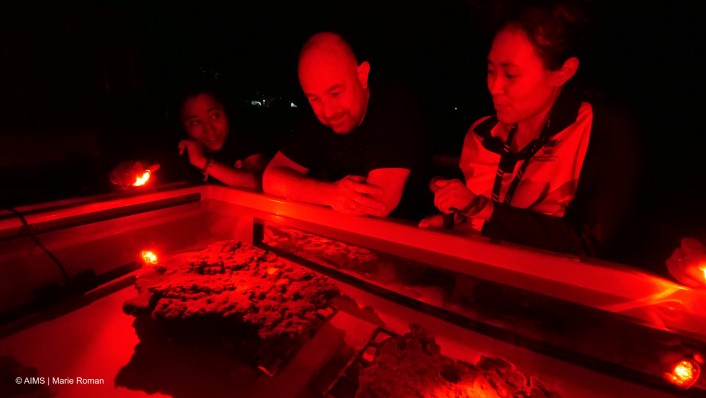
ReefSeed was developed by AIMS as part of the G20 Coral Research and Development Accelerator Program (CORDAP), with the Maldives Marine Research Institute (MMRI) as an implementing partner (for technology transfer, testing and overseas training and application) and CSIRO. ReefSeed applies technologies developed under the Reef Restoration and Adaptation Program (RRAP), funded by a partnership between the Australian Government’s Reef Trust and the Great Barrier Reef Foundation.
How ReefSeed works
The mobile coral birthing-and-rearing unit maintains high-quality water filtration and temperature control using an independent power source, drawing seawater from the ocean through its own temporary pipeline. This supports a multi-phase coral rearing-process:
- Spawning of adult corals from the wild in ReefSeed.
- Automated gamete (egg and sperm) capture and fertilisation of eggs.
- Rearing of coral embryos and larvae.
- Settlement of coral larvae and development into young corals on specialised sheets.
Coral seeding devices are then assembled with the young corals on the sheets for deployment onto reefs.
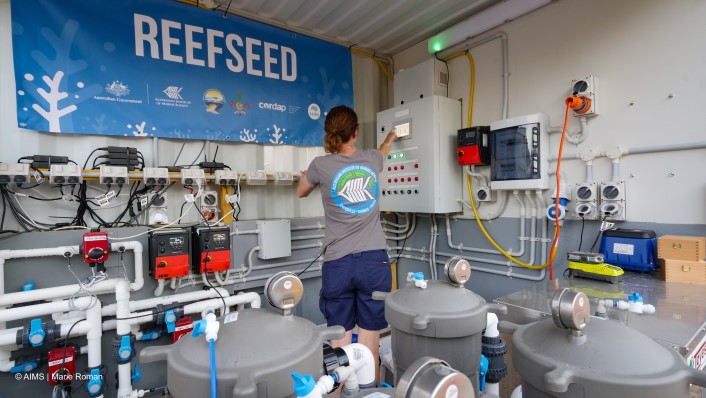
ReefSeed has developed alongside other innovations at AIMS which have allowed scientists to fast-track and up-scale production of young corals for reef restoration. These include the design and testing of coral seeding devices, which help protect juvenile corals once they are back out on the reef.
ReefSeed technology also forms the basis of the coral seeding workflow developed under the Reef Restoration and Adaptation Program (RRAP) allowing high-throughput coral production. This is being tested on the Great Barrier Reef through the Pilot Deployments Program.
A key technological component of the ReefSeed system is the Autospawner, developed by AIMS as part of RRAP. This is a fully automated system which increases the efficiency of the aquaculture process. It is designed to harvest coral eggs and sperm and can produce fertilised eggs in large numbers with minimal manual interference.
ReefSeed success to date
After multiple prototype tests, the first completed ReefSeed unit was put through its paces during the Great Barrier Reef spawning season in late 2024. MMRI biologists and technicians travelled from the Maldives to join the AIMS team, testing and training on the system in preparation for use in their home country in early 2025.
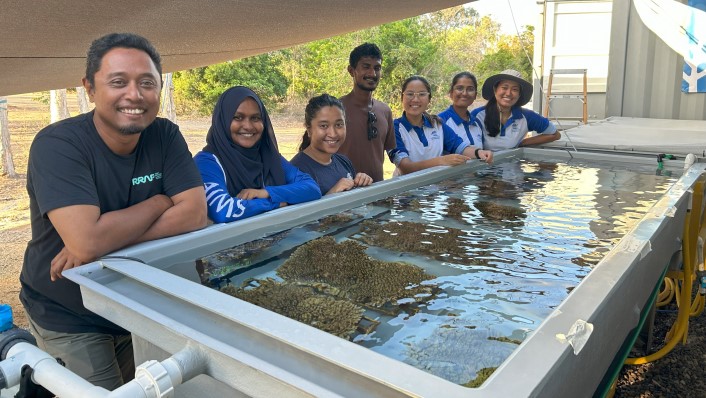
Then in March 2025, AIMS scientists joined MMRI on a small Maldivian island called Maniyafushi in South Male Atoll, where the system was commissioned and operated during a small coral spawning.
The ultimate test came in April 2025 when MMRI staff independently operated the system to spawn and rear corals for deployment. They had great success in operating the system and completing the deployment with only remote support from AIMS. Corals were seeded to eight sites and the first survey of the monitoring and evaluation plan will commence in late 2025.
The AIMS team will return to Maniyafushi to work with MMRI in April 2026 and undertake another, larger spawning and deployment.


