
One size does not fit all: assisted evolution tests on corals bring complex results
Share this:


Assisted evolution methods can help enhance the survival and growth of corals under high temperatures in some cases, but not all corals from all reefs will benefit, new research has found.
The new study led by the Australian Institute of Marine Science (AIMS) applied coral selective breeding and the use of heat-evolved microalgal symbionts to Great Barrier Reef corals and their offspring in the laboratory.
Coral assisted evolution pioneer and senior author Professor Madeleine van Oppen (from AIMS and The University of Melbourne) said the approach aims to accelerate the rate of adaptation and improve coral performance during summer heatwaves.
“Marine heatwaves in our oceans caused by climate change can bleach and kill corals, degrading our reefs,” Professor van Oppen said.
“We have been researching ways we can help corals survive rising temperatures with promising results from our studies in the lab.
“This new research shows that while selective breeding can enhance heat tolerance of young offspring in some instances, the extent to which parents passed on heat tolerance varied according to where the coral parents came from.”
Selective breeding experiment
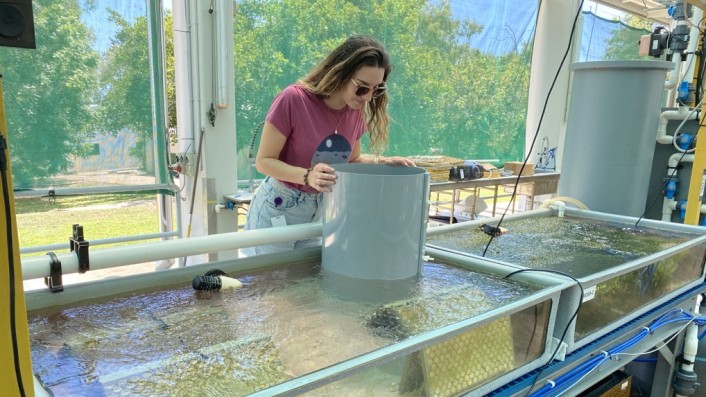
For the experiments, AIMS scientists collected a type of adult coral called Acropora spathulata from reefs in the northern and central regions of the Great Barrier Reef and ranked them according to their heat tolerance as assessed with a widely used, rapid heat stress test.
Gametes (bundles of eggs and sperm) from these corals were used to produce four offspring groups in AIMS’ National Sea Simulator. These were offspring of:
- (1) the most heat-tolerant parents,
- (2) the most heat-sensitive parents,
- (3) parents with intermediate heat tolerance (control group), and
- (4) all parental corals (control group).
The young offspring were inoculated with ‘wild type’ symbionts and then subjected to elevated temperature conditions in the lab for two months.
Symbionts are tiny microalgae which are essential to a coral’s health and live in symbiosis with their hosts providing them with energy to grow and reproduce. Wild type symbionts are the ancestors of the heat-evolved symbionts and have not been lab-evolved under elevated temperatures.
Offspring from the most heat-tolerant Davies Reef parents in the central Great Barrier Reef were found to have enhanced survival and growth in comparison to other selectively bred offspring groups and controls. Offspring corals from the most heat-tolerant Moore Reef parents in the northern Great Barrier Reef showed no improvement in survival and growth.
Adding heat-evolved symbionts
Researchers from AIMS have been exposing cultures of symbionts to elevated temperatures over many years to improve their heat tolerance and help them confer heat tolerance to the corals they have symbiotic relationships with.
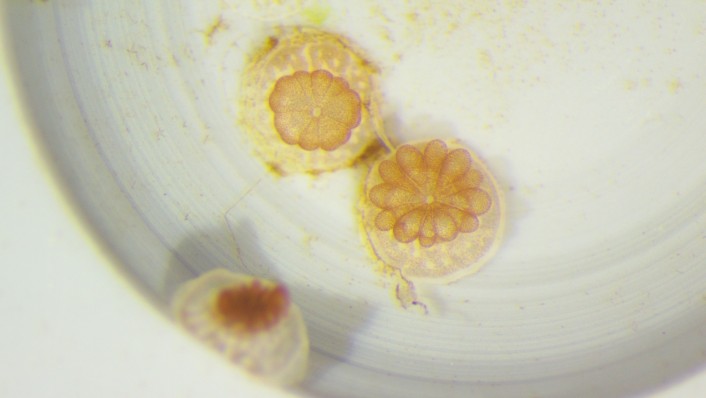
A subset of the young corals produced by mixing gametes of all parents from Davies and Moore Reefs, were inoculated with heat-evolved symbionts to evaluate their impact.
These young corals had enhanced survival at elevated temperatures and better bleaching resilience compared to young corals inoculated with ‘wild type’ symbionts, which confirmed AIMS’ earlier findings. However, there was a trade-off, in that growth at ambient temperature was reduced, which has not been seen previously for heat-evolved symbionts.
Combining the selective breeding and heat-evolved symbiont approaches in a third experiment yielded greater benefits than either intervention alone for young corals from Davies Reef, but little enhancement for those from Moore Reef.
Experiments show promising but varied results
“The inconsistent findings highlight that the results of assisted evolution can vary depending on coral broodstock and offspring environment, as well as coral and symbiont genetics,” Professor van Oppen said.
“We still have much to learn about the inheritance of heat tolerance in corals and future improvements in our experimental heat tolerance tests will help selecting and ranking the parental broodstock for restoration and adaptation purposes.”
This study was published in the journal Science Advances.
Co-authoring institutions include Southern Cross University, Victoria University New Zealand and The University of Melbourne.
The research was funded by the Reef Restoration and Adaptation Program (RRAP), which is funded by a partnership between the Australian Government’s Reef Trust and the Great Barrier Reef Foundation.
Banner image by Giacomo D'Orlando
Share this


