
AIMS pioneers honoured
Share this:


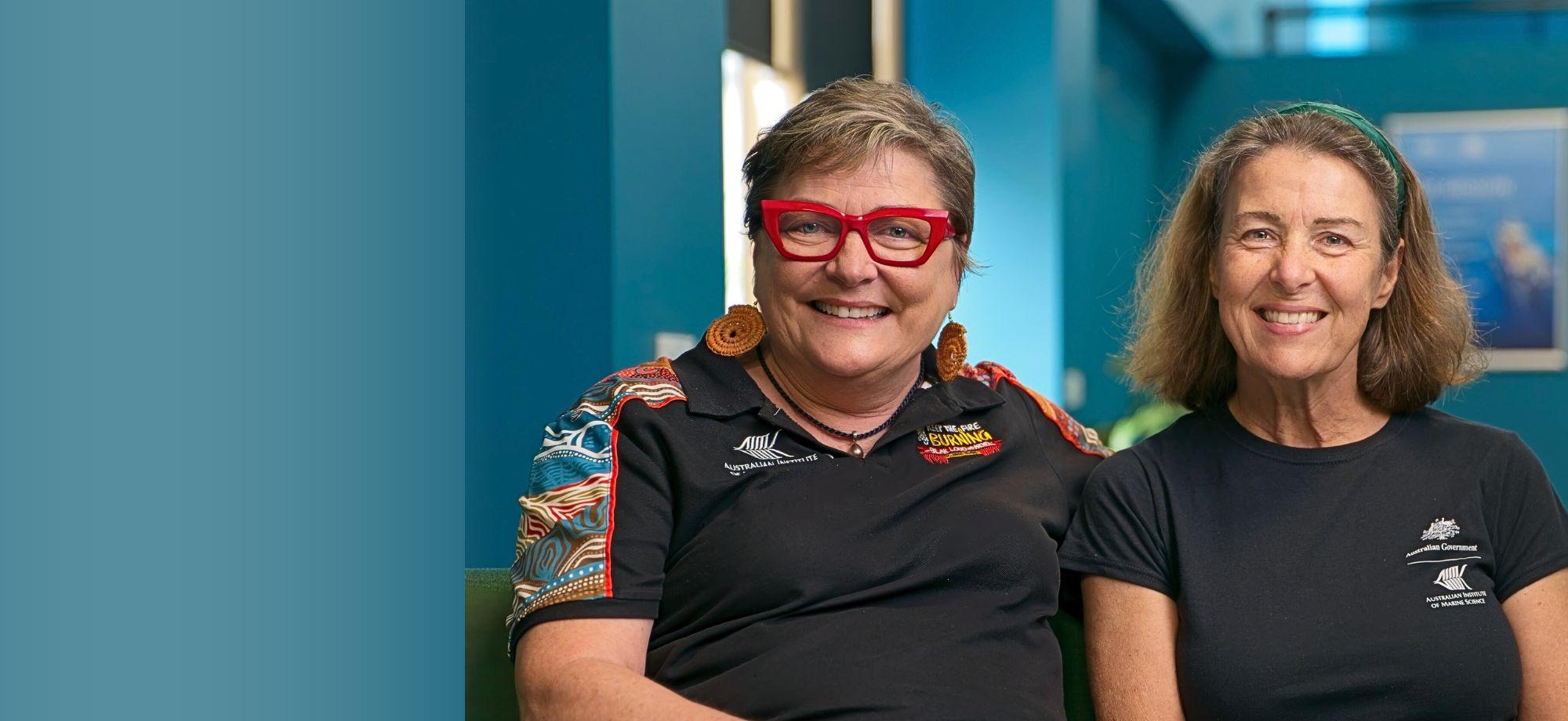
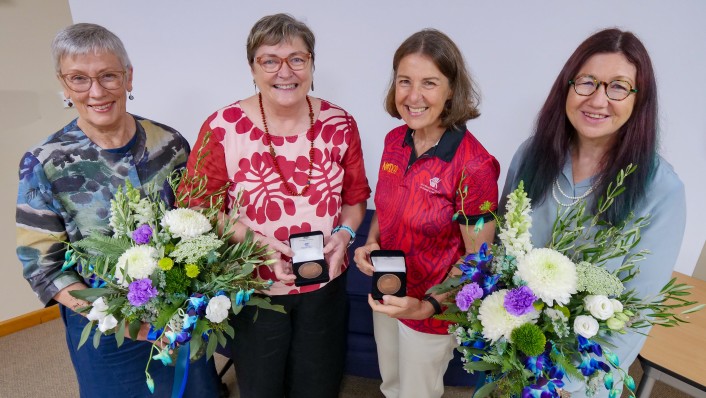
A pioneer in partnering with Indigenous Australians and an international leader in coral reef ecology are the latest recipients of the 2025 AIMS Medal.
AIMS CEO Professor Selena Stead praised the outstanding achievements of Elizabeth (Libby) Evans-Illidge and Dr Katharina Fabricius, for their sustained contribution to AIMS over many years.
“Both Libby and Katharina personify AIMS values, lead by example, and have earned the respect of their peers both in their areas of speciality and more broadly,” she said.
Libby Evans-Illidge
Ms Evans-Illidge established and leads AIMS’ Indigenous Partnerships Program, growing it into a thriving, highly regarded unit, now emulated by other institutions.
Under her leadership, the team transitioned from engagement to genuine partnership.
Ms Evans-Illidge implemented ‘free prior and informed consent’ principles across AIMS, in acknowledgement that Traditional Owners have a central role in deciding which activities can be conducted on their sea Country.
She also introduced two-way knowledge sharing as a foundation for collaboration.
Sea Country
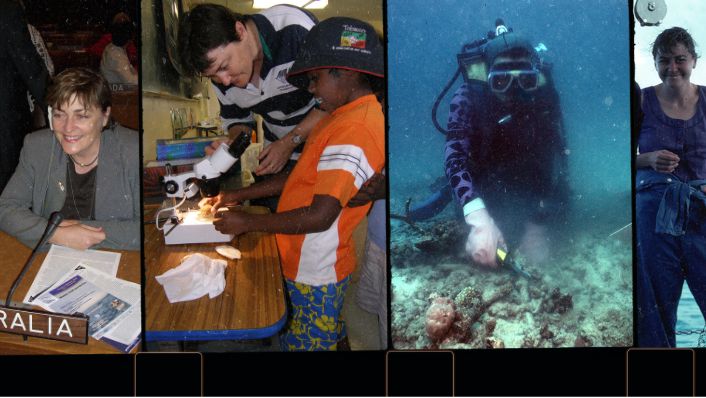
Ms Evans-Illidge joined AIMS in the 1990s, working in the Biodiscovery Prospecting Program.
“We collected marine critters with a view to uncovering novel therapeutics that might have a potential as new medicines,” she said.
“And it really amazed me that we were not engaging with Traditional Owners.
“One of the innovative things we've been able to do at AIMS is get widespread recognition that when we go to sea, we are going onto someone's sea Country, and we need to be showing respect to the Traditional Owners of that sea Country.
“And we've also learnt that the specimens that we might collect, or that we might do experiments with, are part of sea Country too.”
Ms Evans-Illidge said the emerging relationship between scientists and Traditional Owners was based on respect, mutual trust, and understanding.
“To be honest, we might have initially gone into engagement meetings focused on the research that the scientists wanted to do, but as we're getting to know Traditional Owners, we're learning more about their knowledge needs and science priorities,” she said.
“And maybe we can redesign or co-design some of our projects to deliver to Traditional Owners' needs as well; involving the Indigenous rangers in the work as much as possible and providing training and capacity-building to make the most of that opportunity.”
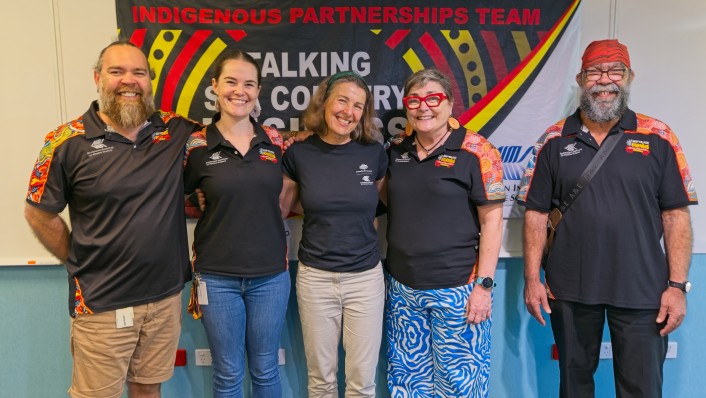
AIMS is now recognised as Australia’s leading science organisation in Indigenous partnership—aligning with the UN Declaration on the Rights of Indigenous Peoples, the Closing the Gap strategy, and the National Marine Science Strategy.
Ms Evans-Illidge also led the world-class AIMS@JCU postgraduate research program for 11 years, becoming a mentor and support to more than 30 students a year.
Dr Katharina Fabricius
Senior principal research scientist Dr Katharina Fabricius is one of AIMS’ best-known scientists, domestically and globally.
In the 37 years since she left Germany to join AIMS as an intern, her pioneering research has transformed understanding of the effects of human impacts on coral reefs, especially through ocean acidification (an impact of climate change) and land run-off on marine water quality.
More recently, as part of the Reef Restoration and Adaptation Program, Dr Fabricius led research on understanding natural processes limiting reef recovery—knowledge critical to understand future reefs and to inform management actions such as reef restoration.
Her team’s research was a key driver in the evolution of AIMS science from observation to understanding the mechanisms and processes needed to develop science-based solutions to the challenges coral reefs are facing in Australia and worldwide.
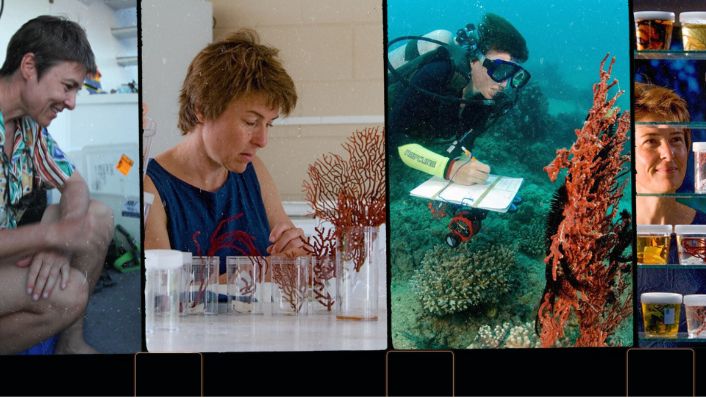
“In early days I studied soft corals and sea fans which are probably the most beautiful components in coral reefs,” she said.
“I was probably attracted by aesthetics more than anything because they're not very useful. I mean, who needs soft corals? They don't build reefs, but they're incredibly colourful and attractions for divers.”
Her book ‘Soft corals and sea fans’ (2001) was the first comprehensive book on this diverse group of organisms.
Water quality
Dr Fabricius said soft corals were highly sensitive to water turbidity and sedimentation.
“At that time, there was very little data about water quality,” she said.
“We were one of the earliest groups to document that run-off sediment and nutrients strongly reduces the biodiversity of reefs, makes macro-algae grow, reduces soft corals and reduces the ability of reefs to recover.
“That's one of the areas I'm proud of. Research that I've contributed to and led has been taken up through water quality guidelines and through government investment to protect reefs.”
Ocean acidification
Dr Fabricius said as coral bleaching became more frequent, she realised that another water quality issue linked to carbon dioxide pollution was ocean acidification.
“Carbon dioxide emissions make seawater slightly more acidic, and that makes it really difficult for coral reefs that are made of calcareous skeletons,” she said.
Dr Fabricius said ocean acidification was still an understudied area and one of the big unrecognised threats to our oceans.
“AIMS supported me to launch 10 expeditions to Papua New Guinea to study coral reef communities exposed to the volcanic seeps where pure carbon dioxide is bubbling out of the sea floor,” she said.
“We looked at different aspects of reef ecology and how they're changing under ocean acidification.”
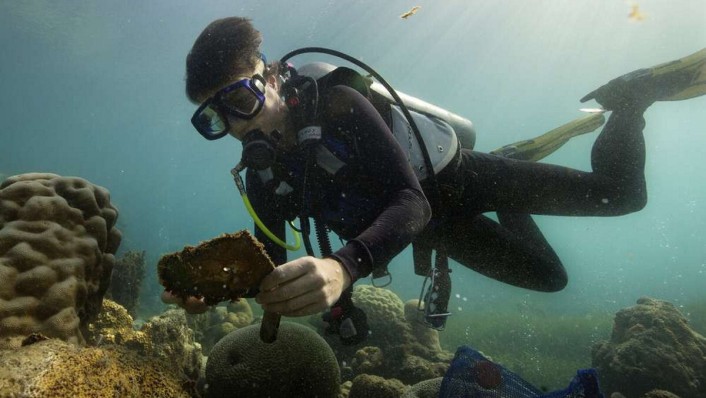
This research revealed the potential fate awaiting tropical marine ecosystems in coming decades as atmospheric levels of carbon dioxide continue to increase. It also identified the main ‘losers and winners’ in coral reefs under ocean acidification.
The collaborative project resulted in more than 40 publications and featured in the 5th Report of the Intergovernmental Panel on Climate Change (IPCC).
Collaboration and global leadership
She said AIMS was amazing in the many different disciplines it housed, the way they collaborated, and the uptake of new ideas throughout the organisation.
“AIMS is allowing us to be global leaders and share what we're learning with Australia’s low-income neighbours,” she said.
Dr Fabricius is a recognised international leader in coral reef ecology with more than 200 published journal articles, book chapters and books across a wide range of topics which have been cited more than 32,000 times in other scientific studies.
Her research has informed policy, regulatory and practical solutions to protect the marine environment, with 88 of her publications cited in 494 policy documents for organisations including the United Nations, OECD, and World Bank.
Share this


