
The challenge
In Australia, the cost of decommissioning offshore oil and gas infrastructure at the end of its operational life is estimated to be US$40.5 billion involving approximately 1000 wells and more than 8000 km of pipeline.
To help inform decommissioning decision making, scientists, including those at AIMS, are working to understand in more detail the impacts of what happens when we remove infrastructure fully, leave it partly in place, or repurpose it after it has reached the end of its operational life.
One of the areas of enquiry is related to potential impacts on the marine environment from contaminants like NORM (Naturally Occurring Radioactive Material) and mercury, which can accumulate in structures like pipelines to higher levels than found in nature.
The approach
To help manage the risk of NORM and mercury contaminants in offshore decommissioning, researchers from AIMS and ANSTO (Australian Nuclear Science and Technology Organisation) co-developed a risk assessment framework on behalf of the National Decommissioning Research Initiative (NDRI).
They worked with experts from an Independent Advisory Group comprising regulatory, risk and contaminant specialists.
The framework provides a structured approach to assess contaminant risks from leave in-situ decommissioning options and has been tailored specifically to the offshore oil and gas sector.
Key features include a focus on end-of-life offshore infrastructure decommissioning and its application to in-situ decision-making for NORM and mercury. It supports alignment with Australian and international regulatory expectations and promotes data-driven, scientifically grounded evaluations. The framework has been presented to several industry conferences and workshops, ensuring stakeholders are informed.
The impact
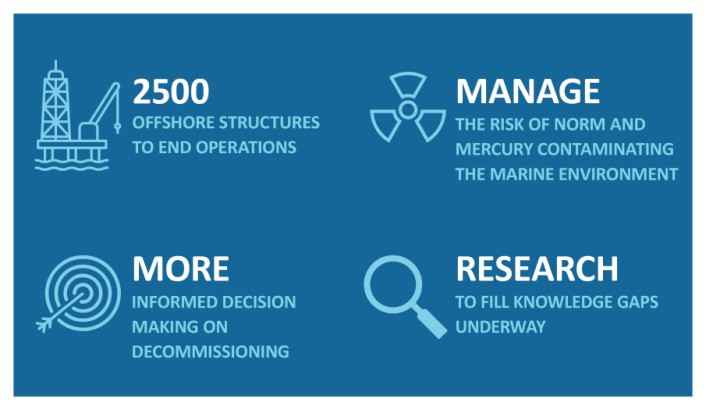
The framework contributes to decision making around whether to remove disused oil and gas structures, or leave them fully, or partly in place, enhancing our national capacity to responsibly manage offshore decommissioning.
AIMS and ANSTO are now being engaged to support the application of the framework in and outside Australia. The framework has highlighted knowledge gaps that AIMS and ANSTO are now researching.


