
Long-Term Monitoring Program
Great Barrier Reef Annual Summary Report
of Coral Reef Condition 2025-2026
Monsoon relief supports initial recovery from recent bleaching
11th August 2026
Download the 2025-2026 report | 5.6MB
Download the 2025-2026 report | 5.6MB
Executive summary
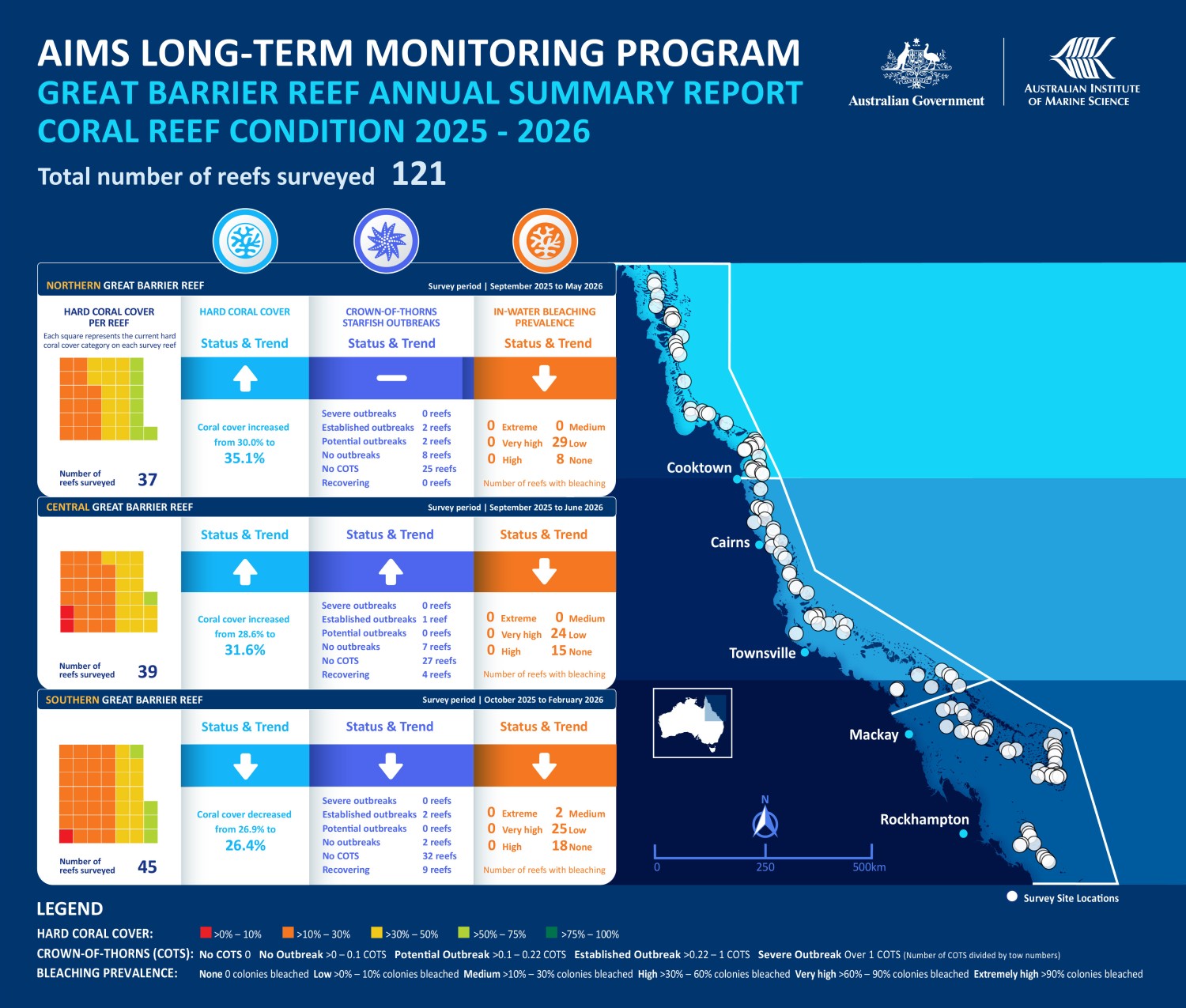
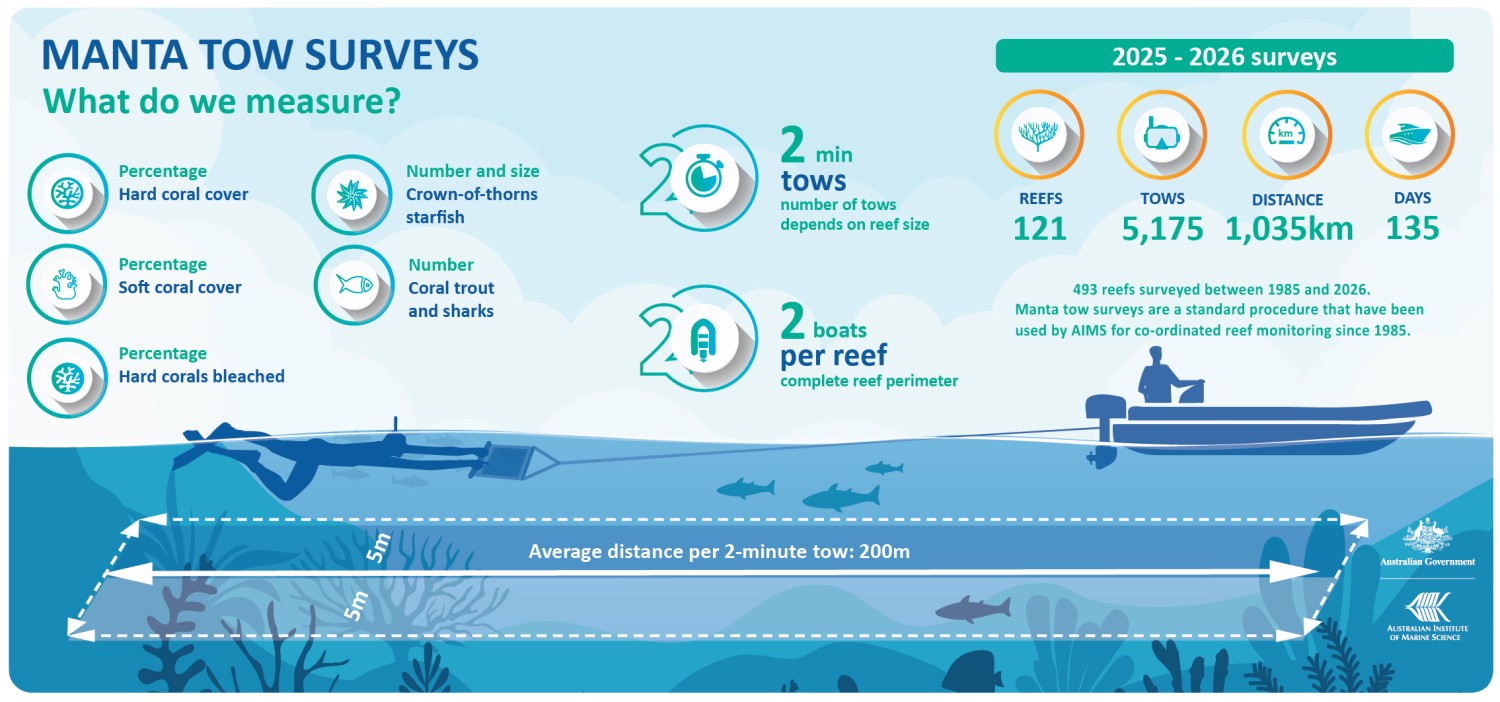
- This report summarises the status (percentage hard coral cover) of reefs in the Northern, Central and Southern Great Barrier Reef (GBR) during the 2025-26 field season. Data were collected during manta tow surveys on 121 reefs by expert scientists of the Long-Term Monitoring Program (LTMP) between August 2025 and June 2026 (reported as ‘2026’).
- In 2026, hard coral cover across all three regions of the GBR increased slightly or remained similar to levels recorded in 2025, signalling the start of recovery from the impacts of the 2024 mass bleaching event.
- In 2026, 16% of surveyed reefs underwent a decline in percentage coral cover, 56% showed no net change, and 28% had an increase.
- Of the 121 reefs surveyed, only three reefs had hard coral cover <10%. Most reefs (64) had coral cover between 10% and 30%, 42 reefs had cover between 30% and 50%, 12 reefs had coral cover between 50% and 75%, and there were no reefs with cover >75%.
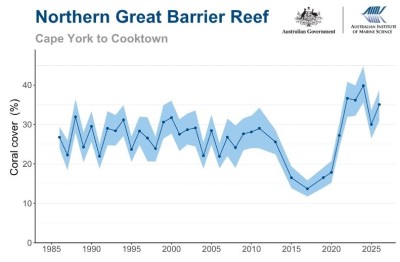
- On the Northern GBR, region-wide average hard coral cover increased from 30.0% (26.4–33.6% credible intervals; CIs) in 2025 to 35.1% (30.9–38.8% CIs) in 2026. This is an increase of 16.7% relative to 2025, and coral cover remains above the long-term average of 27.0% (25.0–29.3% CIs).
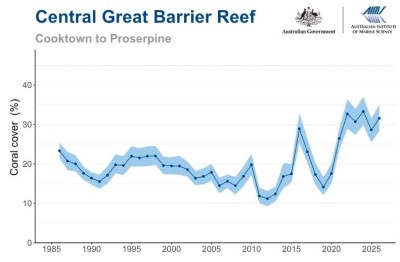
- On the Central GBR, region-wide average hard coral cover increased from 28.6% (25.4–31.5% CIs) in 2025 to 31.6% (28.3–35.1% CIs) in 2026. This is a relative increase of 10.2% compared to 2025, but the estimate remains within the margin of error, with 2026 hard coral cover above the long-term average of 20.0% (18.9–21.4% CIs).
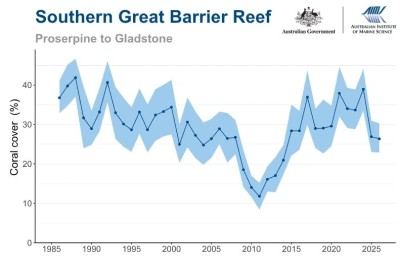
- On the Southern GBR, region-wide average hard coral cover was relatively stable although decreased slightly to 26.4% (22.9–30.2% CIs) from 26.9% (23.0–30.9% CIs) in 2025. This represents a relative decline of 2.0% of 2025 levels, which is within the margin of error, and regional coral cover remains below the long-term average of 29.3% (27.5–31.3% CIs).
- Crown-of-thorns starfish (COTS) were detected on 27 surveyed reefs in 2026, with feeding scars observed on a total of 77 reefs indicating that low numbers of COTS were present on many reefs despite not being observed. No Severe Outbreaks were recorded. Established Outbreaks occurred on two reefs in the Northern GBR, one reef in the Central GBR and two reefs in the Southern GBR. A fifth wave of outbreaks is emerging in the Northern GBR.
- The summer of 2025–26 accumulated less heat stress than the previous two summers, although sea surface temperatures remained 0.7–1.2°C above average across the Great Barrier Reef. Thermal stress peaked in February, reaching National Oceanic and Atmospheric Administration (NOAA) Coral Bleaching Alert Level 2 in parts of the northern GBR. Cyclones, flooding and COTS also affected parts of the Reef.
- Late-summer monsoon activity increased cloud cover and reduced sea temperatures, likely limiting the severity and extent of bleaching. Nevertheless, manta surveys revealed low levels of bleaching across the GBR, and a regional coral bleaching event was declared in the Great Barrier Reef Marine Park Authority’s Northern Management Region (Northern and Central GBR in this report).
- Surveys conducted in 2026 found only limited impacts from the 2025 coral bleaching event. Substantial declines were uncommon, although coral cover remained stable on many reefs rather than increasing. This highlights that bleaching impacts can vary markedly between events and do not always result in substantial coral mortality. The severity of impacts depends on factors such as the intensity and duration of heat stress (which was lower in 2025 than in 2024), local environmental conditions, and the condition of reefs before the event. While many reefs did not lose coral cover, bleaching likely prevented the continued increases in coral cover that would normally be expected in the absence of disturbance.
- Two cyclones crossed the GBR over the summer: Cyclone Koji (category 1) in the Central GBR in January 2026 and Cyclone Narelle (category 5) in the Northern GBR in March.
- Cyclone Koji caused minor coral losses on several reefs in the Central GBR. Most surveys in the Northern GBR were completed before Cyclone Narelle passed through the region, limiting our ability to assess its impacts. Two offshore reefs near Lizard Island that were surveyed after the cyclone had reef-wide declines in coral cover of up to 5%, despite being located approximately 150km from the cyclone’s track. A more comprehensive assessment of Cyclone Narelle’s impacts will be possible following surveys in 2027.
- Despite another summer of above-average sea temperatures, hard coral cover remained stable or increased across much of the Great Barrier Reef, demonstrating the capacity of many reefs to withstand and recover from disturbance when stress is limited and conditions are favourable.
- Examination of coral composition data from permanent sites revealed the impacts of the 2024 coral bleaching event were taxonomically uneven and largely driven by declines in fast-growing, bleaching-sensitive Acropora corals.
- Impacts from the 2024 coral bleaching event revealed that intense heat stress >10-degree heating weeks (DHWs) in the Southern GBR increased the prevalence of severe bleaching and coral mortality in deeper reef habitats across most coral taxa groups.
- The Great Barrier Reef remains under pressure from climate-driven disturbances, tropical cyclones and COTS outbreaks. Although coral cover remained stable in 2026 and continues to be higher than on many coral reefs globally, maintaining healthy coral populations will depend on limiting future warming and preserving the capacity of reefs to recover between disturbance events.
Download the 2025-2026 report | 5.6MB
More information
- Download the 2025-2026 Report
- Take a 'Quick Look' at the 2025-2026 results
- Read the media release
- Learn more about AIMS Long-Term Monitoring Program
- Visit the Reef Dashboard for data on individual reefs and sectors
- Access the data: AIMS Long-Term Monitoring Program: Crown-Of-Thorns Starfish And Benthos Manta Tow Data (Great Barrier Reef)
- Contact media@aims.gov.au


