

AIMS has been monitoring mass bleaching throughout the Great Barrier Reef since the early 1980s, and reefs in Western Australia since the early 1990s.
Mass bleaching events on the Great Barrier Reef have been documented with full-scale surveys in 1998, 2002, 2016, 2017, 2020, 2022, 2024 and 2025.
In Western Australia, mass bleaching events were documented in 1998, 2011-2013 and 2016, with many smaller bleaching events around those times.
AIMS also studies the coral bleaching response, heat tolerance levels and the ability of different coral species to adapt to heat stress. This lets us better predict and model future scenarios for reef managers.

Mass coral bleaching
At a local level, many stressors can cause corals to bleach, including storms, disease, sediments and changes in salinity.
However, the primary cause of regional, or mass, bleaching is increased sea temperatures.
Mass bleaching involves many corals from many different species, and can result in widespread mortality.
The frequency, intensity and area of heat stress causing coral bleaching is increasing over time, as a result of changes to the Earth’s climate.
Mass coral bleaching events do not necessarily affect all reefs equally.
When bleaching becomes common across many sectors of the Great Barrier Reef, including both inshore and offshore reefs, it becomes a mass bleaching event.
In Western Australia, mass bleaching on Kimberley reefs in the far north has historically occurred during El Niño conditions, and La Niña conditions for reefs further south, although that separation has broken down in recent years.
In 2008 and 2011, coral bleaching at the Great Barrier Reef was caused by an influx of freshwater affecting local reefs exposed to the flood plumes.
What are degree heating weeks?
NOAA Coral Reef Watch degree heating weeks (or DHW) is a widely used tool used to measure accumulated heat stress in an area and predict coral bleaching risk throughout tropical coral reef ecosystems.
It is calculated by combining the intensity of daily temperature extremes and the total time when daily temperatures exceed the bleaching threshold over the previous three months. Significant coral bleaching is predicted above 4 DHW and coral mortality is expected above 8 DHW.
Degree heating weeks are a NOAA heat stress product.
2025
In April 2024, the NOAA Coral Reef Watch confirmed the world remains in the 4th Global Bleaching Event, which began in 2023. Mass bleaching has now been confirmed in 83 countries.
Great Barrier Reef and Torres Strait – as of May 2025
A mass bleaching event occurred on the Great Barrier Reef in 2025. The event was the sixth since 2016 and, while less extensive than the bleaching event in 2024, it is the second time the Reef has experienced consecutive events (2016-2017 & 2024-2025).
Prolonged heat stress in the northern regions of the Great Barrier Reef prompted aerial surveys between Townsville and Cape York in March 2025. Aerial surveys of 281 reefs across the Torres Strait, the entire northern Great Barrier Reef and some reefs in the central region revealed widespread coral bleaching. Aerial surveys were not carried out over the Southern region, as levels of heat stress in this area were not high enough to cause concern.
Coral bleaching prevalence was highest between Cooktown and Cape York with 41% of the 162 mid-shelf and inshore reefs surveyed with medium to high bleaching prevalence (11-60% bleached). The majority of offshore reefs (99% of the 96 offshore reefs) had low to medium bleaching (between 1 and 30% bleaching).
78 of the 281 reefs surveyed (27% of the total) had high (between 31 and 60% bleached) and very high (between 61 and 90% bleached) levels of bleaching. 85 reefs had medium (between 11 and 30% bleaching) bleaching prevalence.
The Torres Strait was less affected by bleaching, however 21.7% of the 23 reefs surveyed had medium bleaching or higher.
Bleaching prevalence was more moderate than the 2024, 2016 and 2017 events. No survey reefs exhibited extremely high bleaching (>90% bleached) and 30 reefs had very high bleaching prevalence (between 61and 90% bleached). However, only 6% of the surveyed reefs had no signs of bleaching.
Extensive flood plumes from record rainfall in the Central region delivered freshwater and associated sediments and nutrients onto reefs between February and April. Flood plumes can cause coral bleaching and mortality due to low salinity. Some mortality was recorded around the Palm Island group to the north of Townsville.
A summary of the aerial survey results within the Great Barrier Reef Marine Park is published in the Reef Summer Snapshot 24/25. This event continues to unfold, and it will be many months before the outcomes are understood.
Western Australia – as of May 2025
Coral bleaching from heat stress has been confirmed across thousands of kilometres in Australia’s North West in 2025, from Ningaloo near Exmouth in the south, the Pilbara, inshore Kimberley, the Rowley Shoals and to Ashmore Reef in the far north.
Many reefs recorded their highest levels of heat stress and coral bleaching, although levels of bleaching among regions and reefs vary from moderate to extreme.
This widespread event was the first major coral bleaching event at Ningaloo since 2011-2013, and the first mass bleaching on record across the inshore Kimberley and at the Rowley Shoals. For other reefs, such as at Ashmore, Scott and the Pilbara region, the 2025 bleaching event is one of several to have occurred in the last decade. For Ningaloo and more southern reefs, coral bleaching was still underway in May 2025.
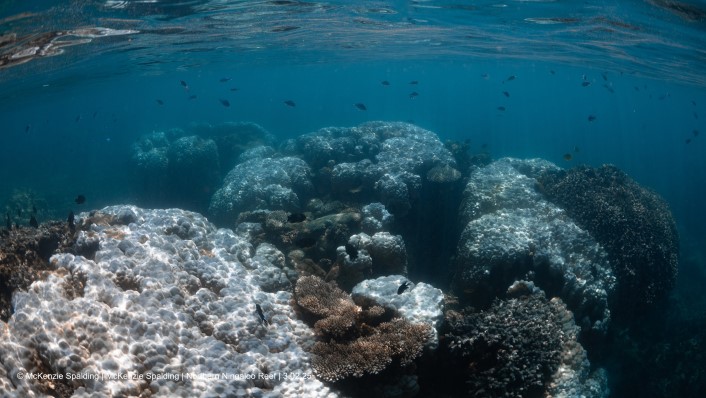
A marine heatwave across much of Australia’s northwest reached unprecedented levels from December 2024 through to April 2025. In January and February, there were extremely high levels of heat stress (+3 to 4°C) off the Kimberley coast. A southward shift in heat created similar conditions along the shelf from the Pilbara to Ningaloo and Shark Bay.
In February 2025, the late arrival of the monsoon, storms and cyclones brought some cooling to these regions, particularly off the Kimberley coast. However, higher than normal temperatures persisted in the Pilbara and Ningaloo regions through March and April.
The late arrival of the monsoon, coupled with other atmospheric conditions, meant the heat stress was unique in its timing for this region, arriving months before peak heat stress was anticipated for Western Australian reefs (typically March/April).
It will take time to understand the full extent of the event which will be quantified with long term monitoring and other survey data. In August 2025, the WA coral bleaching group convened by AIMS published a report on the state of knowledge around the event.
Western Australia 2025 coral bleaching event update
Read:
2024
Great Barrier Reef and Torres Strait – as of April 2024
In March 2024, the fifth mass bleaching event on the Great Barrier Reef was confirmed. It is part of the 4th global bleaching event, which began in 2023 in the northern hemisphere. The event has occurred during an El Niño year and followed the hottest year on record.
As of April 2024, observations indicate this event is one of the more extensive and serious on the Reef. Almost half the reefs (46%) in the Great Barrier Reef experienced record levels of heat stress. Nearly 60% of reefs in the Great Barrier Reef were exposed to levels of heat stress that causes coral bleaching and increases the risk of mortality from bleaching. However, as with previous bleaching events, the full impact of the event will not be known for some time. Bleaching is variable, and in-water surveys are continuing.
Aerial survey results show 73% of surveyed reefs in the Great Barrier Reef Marine Park have prevalent bleaching (more than 10% of coral cover bleached) and 6% in the Torres Strait. For the first time, extreme bleaching (more than 90% of coral cover bleached) was observed in all three regions of the Great Barrier Reef. Very high bleaching (61-90% coral cover bleached) and extreme bleaching (more than 90% coral cover bleached) was observed on 39% of reefs across the entire Marine Park, but concentrated in the southern and central regions. In the southern region, inshore reefs included in both aerial and in-water surveys around the Keppel Islands experienced the highest level of heat stress ever recorded on the Great Barrier Reef – 12 to 15.5°C-weeks using the National Oceanographic and Atmospheric Administration (NOAA) 5km Degree Heating Week product. There was little to no bleaching observed on 94% of survey reefs in the Torres Strait.
Detailed findings of the aerial survey
Visit the Reef Authority's Reef Health Updates for the latest information on the 2024 event.
2022
Great Barrier Reef
In 2022, aerial surveys confirmed the fourth mass bleaching event to impact the Great Barrier Reef in seven years. It was the first mass bleaching event caused by heat stress during La Niña conditions, which historically produce cooler summer conditions at the reef, with higher-than-average rainfall and high cloud cover.
Severe bleaching (more than 60% of community coral cover bleached) affected 43% of reefs surveyed. Worst affected was the central region of the reef, where the most heat stress occurred. The majority of the reefs bleached were exposed to moderate levels of heat stress (NOAA Degree Heating Week 5-8°C-weeks), which causes bleaching but lower levels of mortality.
Western Australia
In 2021-22, sea surface temperatures in Western Australia remained in the highest 10% of observations since 1900. Minor coral bleaching was observed in the Kimberley and Ningaloo reefs, and severe bleaching was observed in parts of the Pilbara region.
However, the full extent of bleaching during this and other heatwaves is unknown, given the vast and remote nature of the region.
2021
Western Australia
In late 2021, minor bleaching (less than 5% of coral cover) was observed at Scott Reef in the Kimberley region. Regional heat stress increased significantly over the following months and bleaching at Scott Reef likely increased, but there were no observations of the reefs at this time.
The adjacent Ashmore Reef and Rowley Shoals were also exposed to significant heat stress, however there were no observations at these reefs.
2020
Great Barrier Reef
Aerial surveys by the ARC Centre of Excellence for Reef Studies documented the third mass bleaching event in five years to occur throughout the Great Barrier Reef. Sea surface temperatures in February were the highest recorded in 120 years of observations.
Heat stress extended into the southern Great Barrier Reef and caused high levels of community coral bleaching in this region compared to 2016 and 2017. During the 2020 event, 25% of reefs surveyed had severe levels of coral bleaching.
Nearly 80% of the reefs throughout the Great Barrier Reef were exposed to heat stress levels that cause bleaching (above 5°C-weeks). The majority of the reefs (about 60%) were exposed to moderate heat stress (4-8°C-weeks). Follow up surveys by AIMS’ Long-Term Monitoring Program in 2021 found this did not cause substantial mortality, with ongoing recovery of coral cover detected in communities across the reef.
Western Australia
In early 2020, patchy bleaching was observed at inshore Kimberley reefs. Moderate bleaching (about 20% of cover cover) was observed at Rowley Shoals, which had previously experienced only minor bleaching.
Other oceanic reefs experienced prolonged heat stress, including those at Scott, Ashmore and Christmas Island. However, there were no surveys of these reefs at the time of heat stress.
2017
Great Barrier Reef
Severe coral bleaching affected the central third of the Great Barrier Reef in early 2017, associated with unusually warm sea surface temperatures and accumulated heat stress. This back-to-back mass bleaching in 2016 and 2017 was unprecedented, and collectively affected two-thirds of the Great Barrier Reef. The southern sector avoided intense heat stress and substantial bleaching in both years.
The extent and intensity of bleaching in 2016 and 2017 were documented through the combination of aerial surveys, in-water surveys at the peak of heat stress, and long-term surveys by AIMS’ Long-Term Monitoring Program to assess change in coral cover.
Intense heat stress (above 8°C-weeks) capable of causing widespread coral mortality occurred during the 2017 event, mostly in the central Great Barrier Reef.
Bleaching intensity was severe at 20% of the surveyed reefs. Some bleaching was observed in the southern region, but Long-Term Monitoring Program surveys during the next few years only detected declines in coral cover in reef communities in the northern region (during 2015-17 surveys) and central regions (during 2017-19 surveys), aligning with the intense heat stress footprint.
2016
In 2016, record ocean temperatures led to widespread coral bleaching on Australian reefs. This was part of the third global bleaching event declared by the National Oceanic and Atmospheric Administration (NOAA) in 2015, and the most intense to impact the Great Barrier Reef.
Great Barrier Reef
Between February and May, the Great Barrier Reef experienced record warm sea surface temperatures. Extensive field and aerial surveys found the bleaching was most widespread and severe in the far northern management area, between Cape York and Port Douglas. Bleaching intensity was severe (more than 60% of coral cover) at 38% of surveyed reefs, mostly in the northern Great Barrier Reef. Bleaching intensity decreased along a southerly gradient.
While most reefs exhibited some degree of bleaching, this bleaching varied in intensity (from less than 10% to more than 90% of coral cover) and was patchy throughout most of the central and southern management areas.
In 2016, intense prolonged heat stress capable of causing coral mortality affected more than 30% of the reef. Overall coral mortality documented with in-water surveys (as of June 2016) was 22% for the entire Great Barrier Reef. Coral mortality was highest in the northern section, where heat stress was most intense.
Western Australia
Coral reefs in northwest Australia, including inshore Kimberley, Christmas Island, Scott and Seringapatam reefs, Ashmore and Cartier reefs, and the Rowley Shoals, were bleached by record-breaking ocean temperatures in early 2016-2017. Bleaching was severe (more than 60% of coral cover) at the Scott and Ashmore reef systems, causing widespread mortality.
Read: AIMS northwest Australian coral bleaching update (May 2016)
2008–2011
Great Barrier Reef
Extreme summers in 2008-2009 and 2010-2011 were associated with extremely high rainfall in Queensland. This led to flooding and the discharge of large amounts of freshwater to nearshore reefs, resulting in localised freshwater bleaching.
The reef is likely to experience more frequent and more serious thermal and freshwater stresses in the future, given current rates of global warming due to increasing levels of atmospheric greenhouse gases.
Western Australia
West Australian reefs also bleached through the transition from El Niño to La Niña conditions. The El Niño caused moderate bleaching at some reefs (Scott Reefs) in the far north, while the La Niña conditions caused mass bleaching affected reefs across 12o of latitude along the Western Australian coast in 2010–2011. This was the first recorded warm water coral bleaching for several reef locations in Western Australia, including Ningaloo reef.
2005–2006
Great Barrier Reef
In January and February 2006, a small localised bleaching event took place in the southern Reef, especially around the inshore Keppel Islands. AIMS surveys revealed that, although bleaching was largely confined to this local area, the degree of thermal bleaching was worse than in previous years. Up to 98% of corals bleached on some reefs, resulting in nearly 39% mortality on the reef flats and 32% on the reef slopes.
Western Australia
Heat stress in 2005 caused moderate (less than 20% of cover cover) bleaching at the iconic Rowley Shoals, the first recorded bleaching of this reef system.
2001–2002
Great Barrier Reef
The summer of 2001–2002 saw a mass bleaching event that was slightly more severe than the 1997–1998 event. The first signs of substantial bleaching were reported in January 2002, with the worst over by April.
In response, the Great Barrier Reef Marine Park Authority (GBRMPA) implemented the world's most comprehensive survey of coral bleaching in collaboration with AIMS, the Cooperative Research Centre for the Great Barrier Reef (CRC Reef) and the US National Oceanic and Atmospheric Administration (NOAA). Aerial surveys revealed bleaching in 54% of the 641 reefs observed. Nearly 41% of offshore and 72% of inshore reefs had some level of bleaching. Only 10% of reefs surveyed were documented to have severe levels of community bleaching.
Again, reef recovery was generally good, with fewer than 5% of the reefs suffering high mortality. The worst affected reefs were in the Bowen area, where about 70% of corals died.
1997–1998
Great Barrier Reef
The summer of 1997–1998 was one of the hottest recorded on the Reef in the 20th century. Mild bleaching began in late January 1998 and intensified by February/March. Extensive aerial surveys of 654 reefs conducted by scientists from the GBRMPA showed that 74% of inshore and 21% of offshore reefs had some level of bleaching. Only 11% of the reefs surveyed were documented to have severe levels of community bleaching.
Most reefs recovered fully, with fewer than 5% of inshore reefs suffering high coral mortality. The most severely affected reefs were in the Palm Island area, where up to 70% of corals died.
Western Australia
The heatwave in 1998 caused the first, and most severe, recorded bleaching in a Western Australian coral reef. The mass bleaching at the Scott Reefs affected most corals and reduced coral cover by approximately 80%. Less severe and patchy bleaching was observed some other reefs in the Kimberley and Pilbara regions.
Coral bleaching dictionary
Mass coral bleaching events are complex. The terms used to describe these bleaching events can also be complex.


